About Us

Today

A national non-profit organization based on unceded Algonquin territory in Ottawa, the Caring Society advocates for culturally based and intergenerational substantive equality for First Nations children, young people, and families. Using a reconciliation framework that addresses contemporary hardships facing First Nations families in ways that uplift all Canadians to take action, the Caring Society provides public education, policy guidance, research, advocacy, and support to communities in ways that promote the safety and well-being of First Nations children and young people, so that they grow up safely with their families, be healthy, get a good education, celebrate their languages and cultures, and feel proud of who they are. 

The Caring Society also creates opportunities for children and young people of all backgrounds to collaborate, think creatively about the future, and inspire one another to lead social change. In partnership with compassionate children, youth, educators, researchers, communities, and allied organizations across Canada and around the world, the Caring Society is building a movement where the landscape is one of honour and possibility for First Nations children and their families.

Our History

In the 1980s, First Nations established First Nations Child and Family Service (FNCFS) agencies to reassert jurisdiction over their children and deliver culturally appropriate child and family services. However, the lack of adequate funding and Canada’s flawed funding formula limited the ability of FNCFS agencies to provide culturally appropriate and equitable child and family services. To address these concerns and provide research, policy, professional development, and networking support, FNCFS agencies sought to establish a national organization dedicated to this work. At a national meeting at the Squamish First Nation in 1998, delegates created the Caring Society, and at a second national meeting in Kingsclear First Nation in 1999, delegates approved the plan and elected an interim board of directors.

Image

The Caring Society Logo

Designed by Amanda Strong of Spotted Fawn Productions, the Caring Society’s logo represents Spirit Bear, a cherished symbol representing the 165,000 First Nations children affected by the child welfare case at the Tribunal, as well as the many young people who support reconciliation and culturally based equity.

Gifted to the Caring Society by Carrier Sekani Family Services in 2008, Spirit Bear attends all Tribunal hearings, received an honorary “Bearrister” degree in 2017, and continues to play a central role in the Caring Society’s child and youth engagement and reconciliation education efforts.

Image
Person seated at conference table

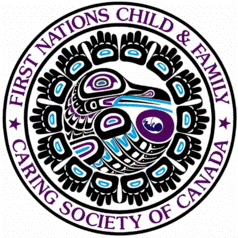
The Spirit Bear logo follows the Caring Society’s original logo, which was designed in 1999 by Mintle-e-da-us Wade Stephen Baker of Sky Spirit Studio, who described the design as follows: 

"This design is a precious and sacred design to us. I first created
The Spirit Bear logo follows the Caring Society’s original logo, which was designed in 1999 by Mintle-e-da-us Wade Stephen Baker of Sky Spirit Studio, who described the design as follows: 

"This design is a precious and sacred design to us. I first created the crow with egg concept in 1995 when my wife was pregnant with our child. I envisioned the crow was the messenger cradling the unborn fetus. I represented the fetus as an egg with a star at that time. I wanted to create a gentle and soft cozy feeling with the work. When the Squamish Nation Social Development office asked my wife and I to create a logo for this important National organization, I immediately thought of the crow with egg as the basic concept. I thought of the saying 'It takes a whole community to raise a child,' and represented that with several hands encircling the crow. I also thought of how important the entire family is in supporting the child. Much of my own healing comes from realizing that alcoholism and addiction is a long-term family disease, and the whole family needs to heal to support a healthy child. The family needs to rally around that child. The hands also represent the first time that all the First Nation's communities have come together to create this important national organization. The hands also represent the importance of celebrating all parts of who we are, all our multiple belongings. All the races are equal partners in protecting Mother Earth and the self-esteem of the child. Our children will Inherit Mother Earth from all their ancestors. The fetus concept came from a flyer we received in our Squamish Nation newsletter about the effects of drugs on an unborn child. This Was an example of a healthy fetus, next to an image of a newborn child going through cocaine withdrawal. My wife and I both wanted a logo that would emotionally and spiritually impact on everyone that the child is precious and must be protected. Our children must feel safe within their own families, and in the womb. The colors reinforce this message. We chose soft purple to represent healing, soft blue to represent serenity and calm - keeping the chaos at bay -and black and white representing the negative and positive forces impacting on the child and family. My wife and I have named the design The Cherished Child."

Mintle-e-da-us Wade Stephen Baker, 1999

Sky Spirit Studio: Art Images, North Vancouver, B.C.

Learn More About 
Our Organization

Image
Group picture of the Spirit Bear's friends

Who We Are

Image
photo of various Caring Society newsletters and annual reports clipped to a clothes line with clothes pins. The backdrop is a green blackboard

What We Do

Image
tight close up shot of a microphone against a blurred background

Presentation Requests